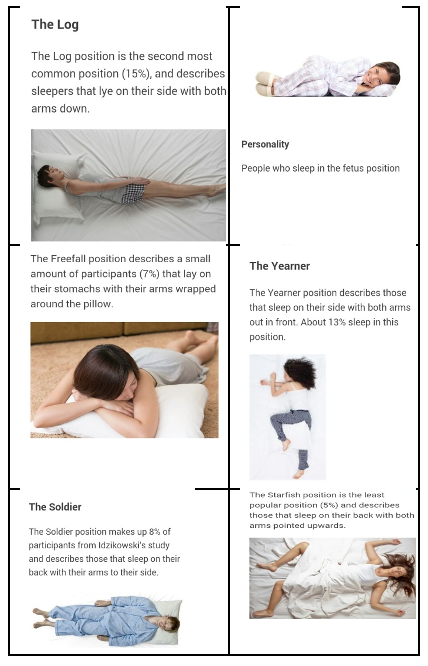
There are many sleeping positions but six are the most common:
- the Log
- the Fetus
- the Yearner
- the Soldier
- the Freefall
- the Starfish
Different surveys vary but a
Canadian survey found that 39% of respondents prefer the Log position and 28% prefer to sleep in the Fetus position. Some articles state that sleeping positions may be related to personality while others mention the connection between sleeping and health effects and impact on the following day. In this article, we will examine the sleeping positions and effects on: (1) infants (2) apparently normal subjects (3) couples and (4) some disease states.
Infants
The recommendation for sleeping positions for infants has changed. In a bestselling book (1958), pediatrician Dr. Benjamin Spock warned against placing a baby on its back because’ if an infant vomits, he’s more likely to choke on the vomitus.; thus, prone position was suggested. Later studies show that placing baby in a prone position increases the risk of sudden infant death syndrome (SIDS).
Sleep position and Heart
Studies have suggested a beneficial effect of the right lateral decubitus position on the heart. In healthy subjects, the study used spectral heart rate variability analysis, determining autonomic effects of three sleeping positions (supine, left lateral decubitus, and right lateral decubitus).Cardiac vagal activity was greatest when subjects were in the right lateral decubitus position.
Obstructive Sleep Apnea (OSA)
It is recommended that people are at risk of obstructive sleep apnea sleep on their side and with a 30′ or higher elevation of the upper body. Snoring is alleviated by sleeping on one’s side.
Couples
It was reported that 50% of heterosexual British couples prefer sleeping back-to-back, either not touching (27%) or touching (23%).
Sleep position and low back pain
Poor sleep position may aggravate low back pain and maybe cause of low back pain in some cases.
Lying on the back is usually considered to be the best sleeping position for a healthy back. It ensures good alignment of the head, neck, and spine. Placing a small pillow under the knees can provide additional support and help maintain the natural curve of the spine.
Fetal position
For people with a herniated disc, adopting a curled-up fetal position may bring relief during the night. Lying on the side with knees tucked into the chest reduces bending of the spine and helps open up the joints.
Pregnancy
According to Mayo Clinic, the best sleeping position during pregnancy.
The following is a summary of the findings of Alaska sleep education center.
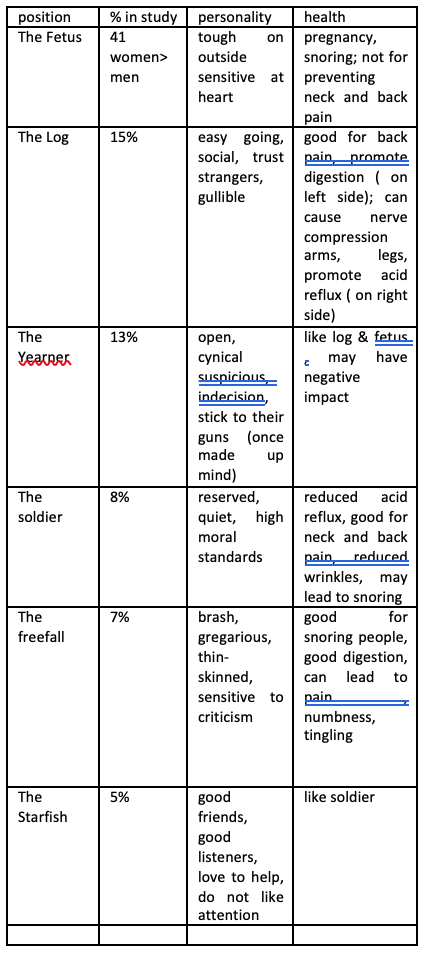
Which position is the best?
There is not really a best position for all people! Each person will have to choose their own sleep position that works best for them.
Personal experience
Nobody sleeps in one position. Personally, I like to sleep on my back, sprawled out with limbs not touching anyone. I put my handset sides. The star fish position (with hands towards the head) is not my forte. When I have back pain, I put a wooden board under the back, and fold a blanket in the hollow of the spine. After about five days, my back pain will go away and I sleep on mattress again. When I have nasal blockade, I sleep on my stomach.
Dr. Ye Win
MBBS, MMedSc(Physiology)
Former teacher at IM2, IM1