A Case Report: Teamwork Makes Life Changing Impact on University Student with Post Surgical Fixation of Cervical Spine Injury (after fall from height)

Author: Dr. Lu Maw Win, M,B.,B.S, M,MED,Sc (Rehab Medicine), TCM (China)
Institution: Rehab Physician & Clinical Director, Rehabilitation Department, Pun Hlaing Siloam Hospital, Yangon, Myanmar
Contact: drlumawwin@phsh.com.mm
Abstract
The team designed and delivered a customized inpatient rehabilitation program to a university student with postsurgical fixation of cervical spine fracture following a traumatic spinal injury. Integrated rehabilitation program (total rehab care with team approach) for 4 months in hospital enabled patient to be ADL-independent accelerating the pre-ambulation stage. This case report outlines how the teamwork approach made an impact on the quality of life of the patient.
Introduction
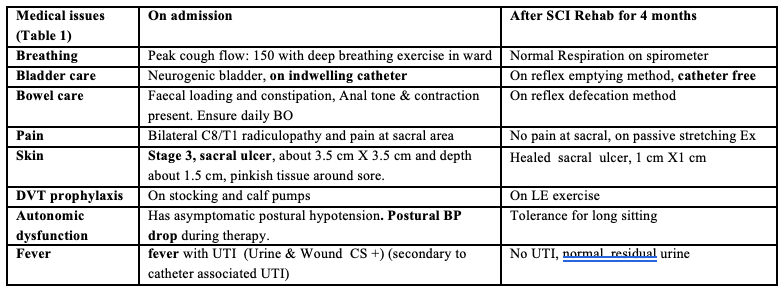
A 20 year old boy with post-spinal fixation of C6/C7 fracture following trauma was admitted to the Pun Hlaing Siloam Hospital (PHSH) for continuation of subacute rehabilitation for SCI. Assessment on admission on the neurological impairment scale was ASIA C (motor incomplete) & NLI C5. On admission, the patient had many comorbidities and poor functional state (as shown in Table 1&2)
The goal of sub-acute SCI rehabilitation was to achieve pre-ambulatory status (upright sitting and standing) as well as ADL independence for the patient.
Methods and Descriptions
Patient-centered rehabilitation treatment was delivered under the leadership of rehabilitation physician, PHSH. Patient underwent an integrated rehabilitation program under a multidisciplinary team approach for 4 months. This program included medical therapy, physical therapy, occupational therapy, nursing services, nutritional therapy, patient and family education etc.
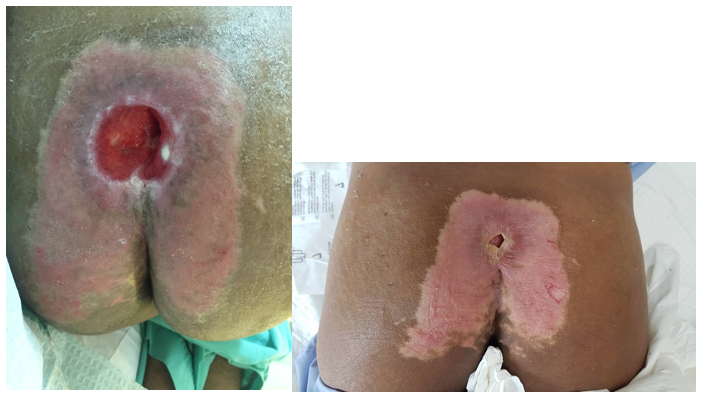
- Medical therapy; daily wound dressing, pain control, DVT prophylaxis, postural hypotension control, residual urine assessment for bladder care.
- Physical therapy; range of motion, strengthening of all intact & affected muscles, pain modalities and upright orientation with Tilt Table/Biodex standing.
- Occupational therapy; ADL retraining, bed/mat mobility, transfer & wheelchair mobility.
- Nutritional therapy; control weight gain with balanced diet.
- Nursing services; bladder and bowel self care with complimentary bed activities.
- Patient family education was done by rehab physician for nature of SCI, treatment available, SCI complications, expected functional outcome & available devices.
Results and Findings
Desired medical and functional status was achieved after 4 months of rehab treatment. Neurological impairment improved to ASIA D & NLI C7. General status has considerably progressed and functionality is more independent. Detail improvement is shown in table 1&2.
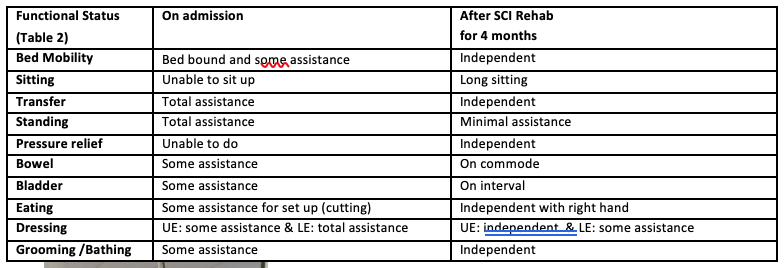
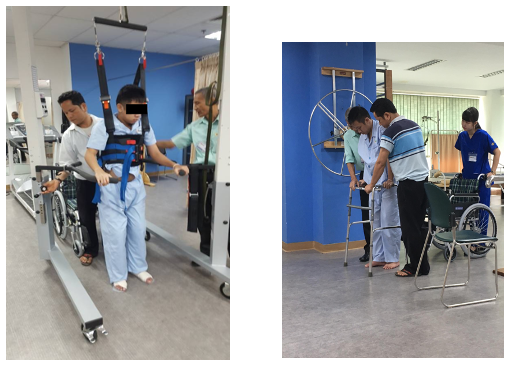
Figure 1: Status on arrival and improvement after 4 months of total SCI Rehabilitation
Discussion and conclusion
As a non-specialized SCI rehabilitation center with limited services in hospital, sub-acute rehabilitation for a SCI patient with co-morbidity was a first for the team to deliver.
However, the integrated and harmonized teamwork coupled with efficient utilization of available equipment and a patient-centered approach resulted in achieving optimal functional outcome.
The rehab team consisting of the rehab specialist and six physiotherapists delivered a personalized and integrated treatment program. This specifically customized program significantly accelerated the patient to be more functionally independent with wheelchair mobility.
This case report is a précis to highlight how a harmonized approach with the right structure, system and people can make an impact on the quality of life of a post-SCI patient.
Acknowledgement
We would like to express our deep appreciation to the patient and family for their trust in us. Moreover, we sincerely thank our colleagues and hospital management team for giving us the opportunity to deliver the most appropriate care for the patient.
Acknowledgement
Interdisciplinary rehabilitation for a patient with incomplete cervical spinal cord injury and multimorbidity: A case report. Vining RD, et al. Medicine (Baltimore). 2017 Aug; 96 (34):e7837
Abbreviation:
SCI=Spinal Cord Injury
ASIA=American Spinal Injury Association
NLI=Neurological Level of Injury
ADL=Activities of Daily Livings
DVT=Deep Vein Thrombosis
UTI=Urinary Tract Infection
UE & LE=Upper Extremities & Lower Extremities