Introduction
The penis does not obey the order of his master, who tries to erect or shrink it at will. Instead, the penis erects freely while its master is asleep. The penis must be said to have its own mind, by any stretch of the imagination. (Figure 1)
Leonardo da Vinci
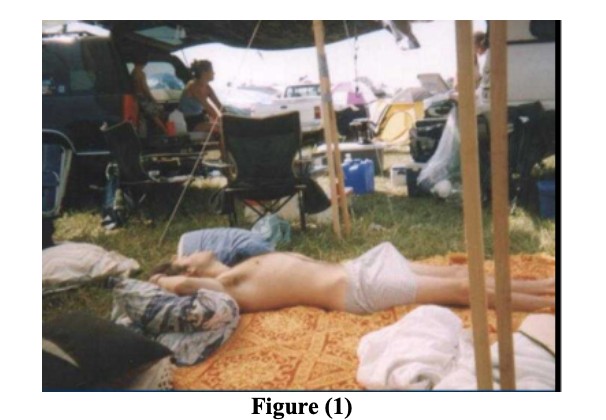
Figure (1)
As the most thoroughly studied sexual dysfunction in the context of epidemiological research, the prevalence of Erectile Dysfunction (ED) is estimated to be 10-20% worldwide. The prevalence of complete impotency tripled from 5-15% between subjects aged 40-70 years. Current data has also confirmed that, the prevalence of ED mounts with the presence of comorbid medical conditions which include Type2 diabetes mellitus, obesity, cardiovascular disease, hypertension, hyperlipidaemia, depression and benign prostatic hyperplasia1. The exact data of Myanmar is not known because the majority are “silent sufferers”. Some people regard it as one of the natural changes due to aging process; others are shy to seek for help and some others think that nothing much can be done to improve it. Actually, all cases of ED can be treated effectively provided the patient has adequate eagerness and compliance.
Erectile Dysfunction
“Persistent inability of a man to achieve and/or maintain an erection sufficient for a satisfactory sexual performance” (NIH Consensus Statement of Impotence 1993).
Much of the current understanding of erectile physiology and pathophysiology was gained in the 1980s and 1990s, and our knowledge of physiology and pathophysiology of ED has increased through the decades. Studies have shown that ED can be an early symptom of symptomatic coronary arterial disease2.
Without proper understanding of the pathophysiology, treatment cannot be successful.The level of success depends on thorough clinical assessment, proper investigation and appropriate treatment which can be a single modality or combination of different modalities. Treatment can be either medical or surgical, or combination of both and has to be tailored according to the underlying pathology and individual expectations.
Physiology of erection
- Penile components and their function during penile erection
Tunica albuginea of corpora cavernous is a very important part. It contains erectile tissue and protects the erectile tissue as well. It provides rigidity of corpora cavernosa. It also participates in veno-occlusive mechanism. - Smooth muscle regulates blood flow into and out of sinusoids.
- Ischiocavernous muscle pumps blood distally to hasten erection and provides additional penile rigidity during rigid erection phase.
- Bulbocavernous muscles compress the bulb to expel semen3.
- Corpus spongiosum pressurizes and constricts the urethral lumen to allow forceful expulsion of semen.
- Glans acts as a cushion to lessen the impact of penis on female organs. It also provides sensory input to facilitate erection and enhance pleasure.
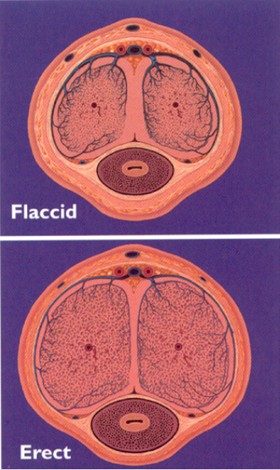
Artist’s cross-sectional drawing of the penis, depicting the inner circular and outer longitudinal layers of the tunica albuginea and the intracavernous pillars. The longitudinal layer is absent in the ventral groove housing the corpus spongiosum. (From Lue TF, Akkus E, Kour NW. Physiology of erectile function and dysfunction. Camp- bell’s Urology Update 1994; 12:1–10.) (figure 2)
Figure (2)
Arteries
The source of penile blood is usually the internal pudendal artery, a branch of the internal iliac artery. In many instances, however, accessory arteries exist, arising from the external iliac, obturator, and vesical and femoral arteries and they may constitute the dominant or only arterial supply to the corpus cavernosum in some men.
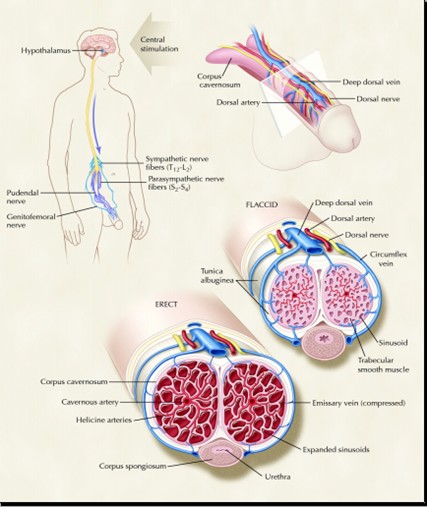
Figure (3) -Arterial supply of the penis(Breza et al,1989)
Veins
The venous drainage from the three corpora originates in tiny venules leading from the peripheral sinusoids immediately beneath the tunica albuginea. These venules travel in the trabeculae between the tunica and the peripheral sinusoids to form the subtunical venous plexus before exiting as the emissary veins.
Neural Supply
The penis usually stays in the flaccid stage, which is under control of sympathetic activity.
Robust erection requires
- Active neural supply, both autonomic nervous system and peripheral nervous system
- Intact arterial supply
- Responsive corporeal smooth muscle and
- Intact venous mechanics(Figure 4)
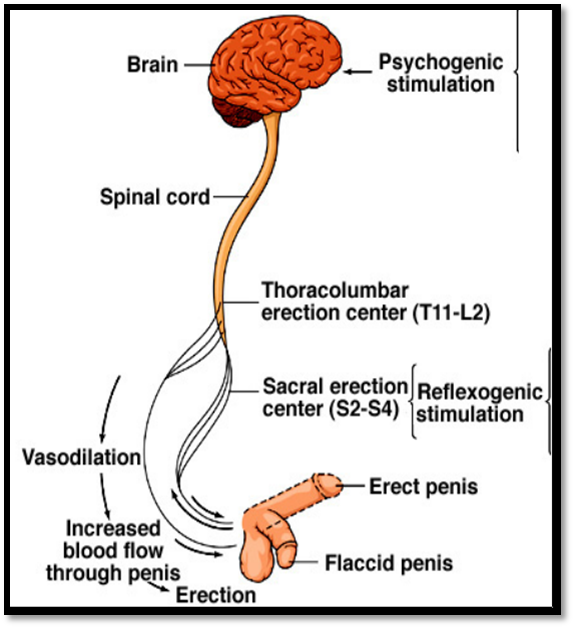
Figure (4)
Both Autonomic (parasympathetic &sympathetic) and Somatic Nervous systems are involved in erectile functions, parasympathetic from S2,3,4 and sympathetic from T10,11,12 joining in pelvic plexus. The pudendal nerve is a branch of pelvic plexus and is the key nerve for erection. The parasympathetic nerve is responsible for tumescence and sympathetic for detumescence. Stimulation of pelvic plexus and cavernous nerve induce erection. Contraction of Ischicavernous muscles produce rigid erection. Rhythmic contraction and compression of bulbocavernosus muscle cause ejaculation.
Cellular perspective of the erection pathway
Cavernous smooth muscle relaxation is key for erection.
Nitricoxide (NO), produced from cavernous nerve endings initiate erection and NO from the endothelium maintains it. On entering the smooth muscle, NO stimulates production of cyclic GMP which activates PKG (GMP-dependent protein kinase). PKG opens potassium channels and close calcium channels. Low cytosolic calcium relax smooth muscle. Cyclic GMP is degraded by PDE5 (phosphodiesterase type 5). That is the rationale for the use of PDE5 inhibitors such as Sildenafil, tadalafiletc for treatment of ED.(figure 5)
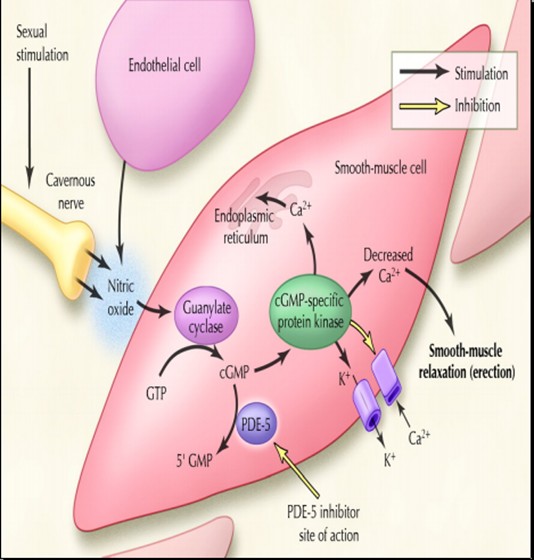
Figure (5) Mechanism for smooth muscle relaxation & excitation
Pathophysiology
Risk Factors
Common risk factor categories associated with sexual dysfunction include the following:
- General health status, diabetes mellitus, cardiovascular disease, concurrence of other genito-urinary disease, psychiatric/psychological disorders, other chronic diseases, and socio-demographic conditions.
- For ED, smoking, medications, and hormonal factors also serve as well-defined risk factors4.
Aetiology
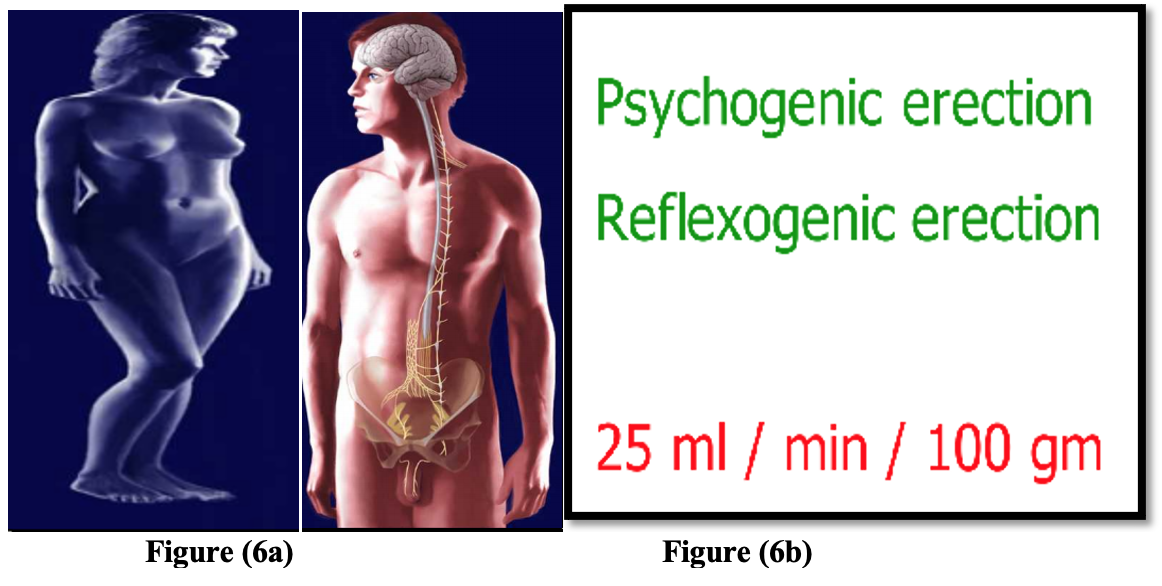
I. Psychogenic(figure 6a) (figure 6b)
- Generalized
- Generalized unresponsiveness 1. Primary lack of sexual arousability 2. Aging-related decline in sexual arousability
- Generalized inhibition 1. Chronic disorder of sexual intimacy
- Situational
- Partner-related
- 1. Lack of arousability in specific relationship
- 2. Lack of arousability owing to sexual object preference
- 3. High central inhibition owing to partner conflict or threat
- Performance-related
-
-
- Associated with other sexual dysfunction (e.g., rapid ejaculation)
- Situational performance anxiety (e.g., fear of failure)
-
- Psychological distress or adjustment related
- Associated with negative mood state (e.g., depression) or major life stress (e.g., death of partner)Psychogenic causes
1. Depression , Stress, anxiety, Psychological trauma
o Erectogenic stimulus
o Neural initiation
II. Organic
- Vasculogenic (most common cause) – (A) Arteriogenic (B) Venogenic/Cavernosal (C) Mixed
- Neurogenic
- Endocrine
- Anatomic
- Miscellaneous
1. Vasulogenic
1. A – Arteriogenic
Among the vasculogenic causes, areteriogenic which is inadeqate blood flow into the cavernosum is the most important one for ED. Arterial blood flow can be reduced because of atherosclerosis related to age, peripheral vascular disease and injury to the blood vessels. Disorder of cavernosum is another contributing cause. Microangiopathy due to diabetes mellitus is a very common etiology worldwide and also in Myanmar.
1. B – Venogenic / Cavernosal
Ineffective veno-occlusive mechanism plays a less important role in causing ED, but unless it is corrected properly if it is a contributing factor, treatment can fail. Degenerative tunical changes and fibroelastic disorders are the causes of defective venom-occlusive mechanism.
1. C – Mixed -both Arteriogenic and Venogenic
In some cases, veno-occlusive mechanism also fails to close and trap the blood while arterial blood flow to the cavernoum is reduced.
2. Neurogenic
Peripheral neuropathy caused by Diabetes Mellitus is a very common cause of ED.
- Spinal trauma and spinal tumours are important causes and so are local injury to nerve pathway (during pelvic surgery or trauma).
- Cavernosal nerve injury can take place inadvertently in Transurethral Resection of prostate (TURP) and Radical Retropubic Prostatectomy(RRP)
3. Endocrine / hormonal
Low serum testosterone can cause libido resulting in ED. But it is not the main cause of ED. Only about 10-11% of cases are related to it. Hyperprolactinemia is another possible cause. Thyroid function disorders have also negative impact on erectile function.
4.Anatomical / Structural causes
Peyronie’s disease and uncorrected penile fracture can lead to ED.
5. Miscellaneous
The following medications and medical conditions can result in ED.
- Drugs – Nifedipine, Betablockers, cimetadine
CRF, Hepatic failure, Multiple sclerosis
III. Mixed (Organic & Psychogenic combined)
This is the commonest type.Patients who have ED due to organic cause develop anxiety and depression resulting in further worsening of the condition.
Diagnosis
In the past, we did exhaustive biochemical screening panel, psychological assessments and occasional vascular testing for the diagnosis of ED. Since 1990, with the better understanding of pathophysiology of ED, this approach has been modified.
Current recommendations include very thorough history-taking focusing on sexual relationship. Complete medical and sexual history is vitally important intrying to find out the cause. It is essential to have the partner or wife at the time of history-taking.
It is also important to distinguish ED from premature ejaculation and loss of libido. The IIEF (International Index of Erectile Function) and EDITS (Erectile Dysfunction Inventory of Treatment Satisfaction) scoring system are useful for initial and subsequent assessments. History with regard to presence of psychological problems and concurrent major life events or relationship issues. Physical examination should focus on Vascular, neurological, endocrine systems. Testes size should be noted and the penile shaft should be examined whether there is any deformity. Clinical examination like Rigiscan or Stamp test is helpful to differentiate psychological from organic cause5.
Investigations should include Hemoglobin A1c and serum glucose, lipid screen and hormonal screening such as early morning testosterone, serum prolactin and thyroid profile.
Duplex ultrasonography may be necessary in selected patients. Selective pudendal arteriography needs to be done if there is a plan for penile revascularization6.
References
- Feldman HA, Goldstein I, Hatzichristou DG, et al. Impotence and its medical and psychosocial correlates: results of the Massachusetts Male Aging Study. J Urol 1994;151:54–61.
- Gandaglia G, Briganti A, Jackson G, et al. A systematic review of the association between erectile dysfunction and cardiovascular disease. EurUrol 2014;65:968–78.
- Gratzke C, Angulo J, Chitaley K, et al. Anatomy, physiology, and pathophysiology of erectile dysfunction. J Sex Med 2010;7(1 Pt 2):445–75.
- Lewis RW, Fugl-Meyer KS, Corona G, et al. Definitions/epidemiology/risk factors for sexual dysfunction. J Sex Med 2010;7:1598–607.
- Lue TF. Erectile dysfunction. N Engl J Med 2000;342:1802–13.Montorsi F, Adaikan G, Becher E, et al. Summary of the recommendations on sexual dysfunctions in men. J Sex Med 2010;7:3572–88.
- Nehra A, Jackson G, Miner M, et al. The Princeton III Consensus recommendations for the management of erectile dysfunction and cardiovascular disease. Mayo ClinProc 2012;87:766–78.
Author Information
Toe Lwin
FRCS, FACS, Dr.Med.Sc
Honorary Professor, Department of Urology, University of Medicine1, Yangon