


The burden of disease
High systolic blood pressure is the leading risk factor for years lost due to ill-health, disability or early death (DALY), estimated to cause 10.7 million deaths and 212 million DALYs globally in 2015 1.and 58% of CVDs in 2013 2
A high percentage of elderly persons have raised blood pressure and may not even be aware of it until complications of hypertension set in. The American Heart Association estimated that almost 80 per cent of adults over 75 have hypertension.
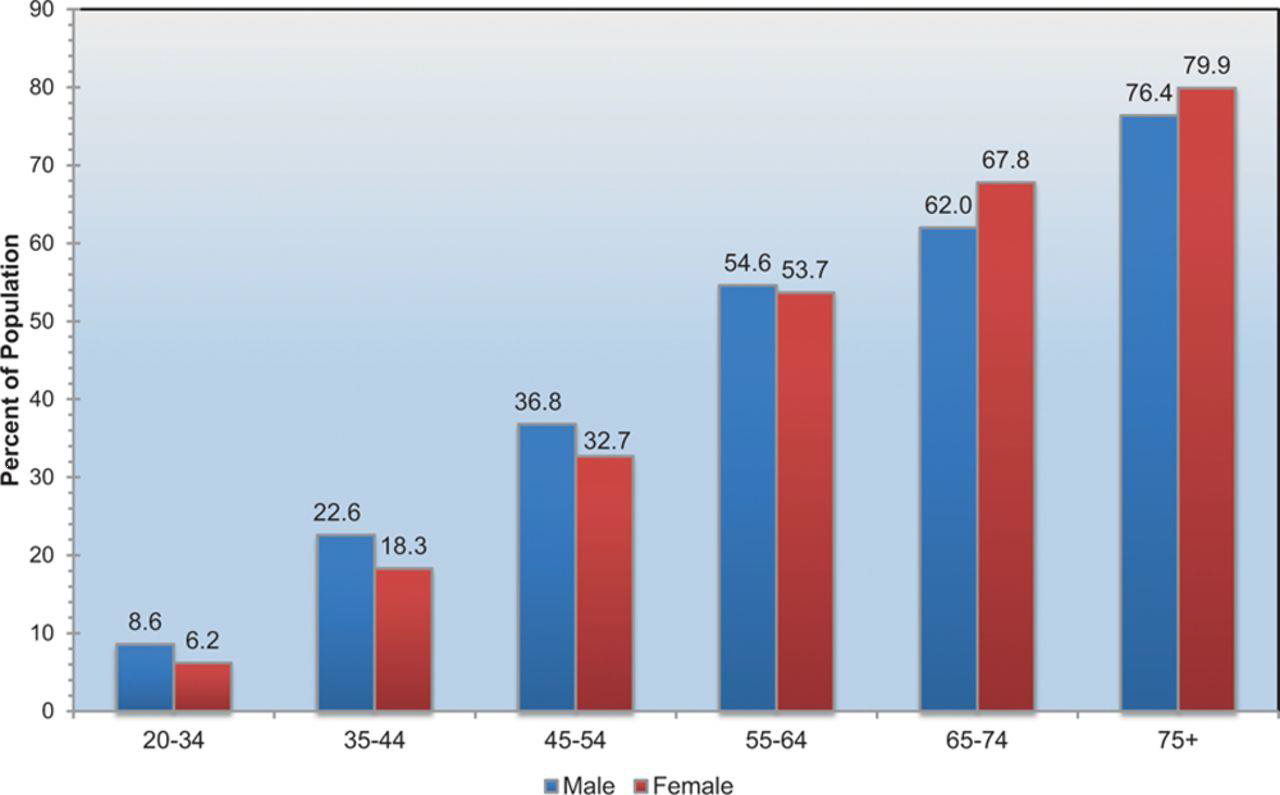
Fig .1- High blood pressure prevalence in adults 20 years and above stratified for age and sex, 2007-2012 (American Heart Association)
Of concern is that the prevalence rates appear to be rising worldwide, including Myanmar.
A study spanning the ten-year period ( 2004 to 2014) reported a significant increase in the age-standardized prevalence of hypertension from 26.7% (95% CI:24.4-29.1) – 34.6% (32.2-37.1) , with an increase of age-standardized mean systolic blood pressure from 122.8 (SE) ± 0.82 mmHg to 128.1 ± 0.53 mmHg and increase in diastolic blood pressure from 76.2 ± 0.35 mmHg to 80.9 ± 0.53 mmHg3.
Normal Blood Pressure
Although the heart pumps out blood only during systole, blood flow is continuous because of the motion created by elastic recoil of vessels during diastole. The adult systolic pressure is considered to be between 90-120 mm Hg and diastolic blood pressure between 60-90 mm Hg. The systolic blood pressure is contributed mainly by cardiac output and diastolic blood pressure by elastic recoil.
Variations in blood pressure
Physiological variations
Since heart rate is a determinant of blood pressure, physiological variations in blood pressure occur with changes in heart rate. Thus, blood pressure (especially systolic BP) rises in exercise, excitement, in hot environments, raised BMR, and consumption of caffeine-containing drinks. There is also a circadian variation in blood pressure, the highest readings being obtained in the late evening and lowest readings observed during sleep. It is therefore extremely important to measure blood pressure at the same time of day, after adequate rest.
The diastolic blood pressure may be lower in pregnancy due to progesterone which causes relaxation of smooth muscles. Blood pressure is much lower at birth, rising steadily to reach adult values by adolescence. When blood vessels become thickened and arteries less elastic with age, the diastolic blood pressure rises.
Pathological variations
In 2017, the American Heart Association, the American College of Cardiology, and nine other health organizations lowered the numbers for the diagnosis of hypertension to 130/80 mm Hg and higher for all adults. The previous guidelines set the threshold at 140/90 mm Hg for people younger than age 65 and 150/80 Hg for those ages 65 and older
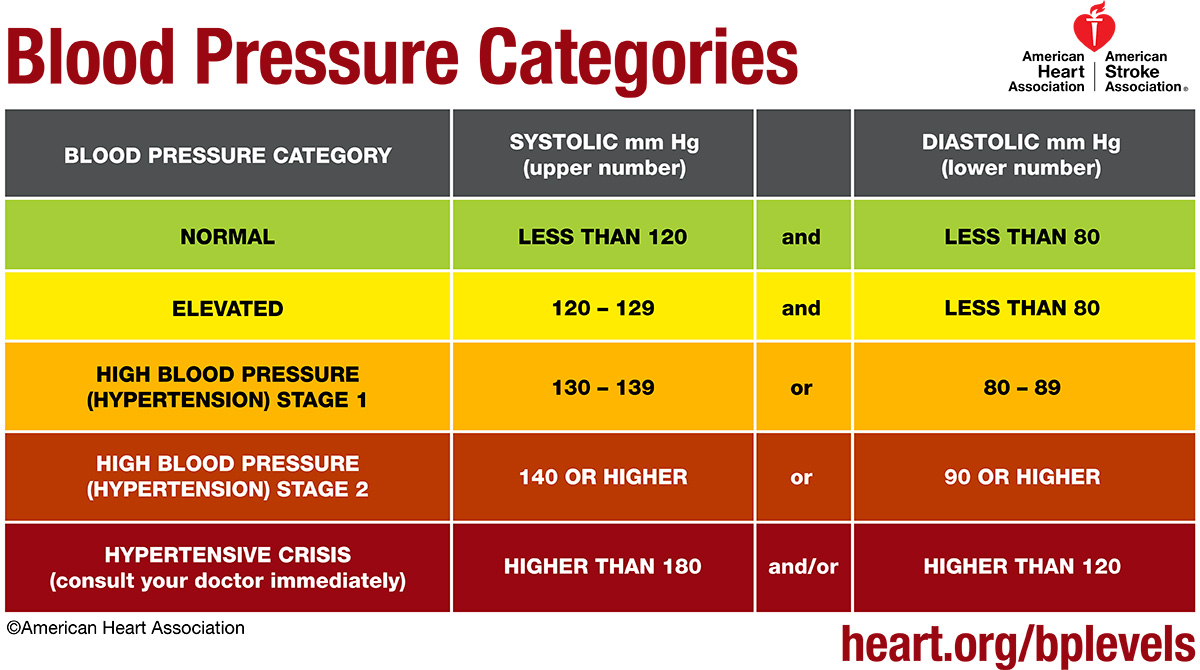
The cause of elevated blood pressure is not evident in more than 95% of cases (“essential hypertension” / “primary hypertension”) 4 but the cause may be identified (“secondary hypertension”) in a small number. These may be renal, hormonal (Cushing’s Syndrome, congenital adrenal hyperplasia etc), drug-induced (steroids, oral contraceptive pills) or pregnancy-induced.
Regulation of blood pressure
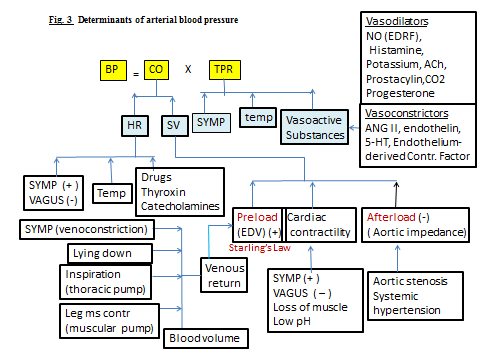
Blood pressure is defined as the lateral pressure exerted on the wall of the blood vessel by the contained blood. This pressure is the product of how much blood comes in (a determinant of the cardiac output) and how much blood is prevented from leaving (peripheral resistance). Thus, Blood Pressure (BP) = Cardiac Output x Total peripheral resistance. (TPR)
Cardiac output is a product of heart rate (HR) and stroke volume (SV). TPR is maintained by arteriolar tone which is a function of the alpha adrenergic sympathetic stimuli originating from the vasomotor centre (VMC). Superimposed on this inherent tone are the influences of hormones, chemicals), thermal and blood gases. The sympathetic nervous system also influences HR and SV. Stroke volume is determined by (a) the end –diastolic volume (EDV) (also termed the “preload”) which is dependent on venous return (b) myocardial contractility which depends on the state of the cardiac muscle, sympathetic activity, pH (c) resistance offered by the aortic valve (aortic impedance; also known as “after load”). Venous return is increased by increased blood volume, inspiration (“thoracic pump”), contraction of leg muscles (“ muscle pump”) , venoconstriction (sympathetic effect), lying down posture.
Because blood pressure variations occur continuously throughout the 24 hours, mechanisms to regulate it and keep it within the “set point” need to be in place. These homeostatic processes occur as short-term regulations (“moment-to-moment” regulation) mediated through the baroreceptors (arterial and aortic sinuses) and peripheral chemoreceptors
(arterial and aortic bodies) ; and long-term regulations mediated through the renin-angiotensin system (RAS). The thirst and ADH mechanisms also influence blood pressure indirectly, through regulation of blood volume.
Short-term regulation of blood pressure
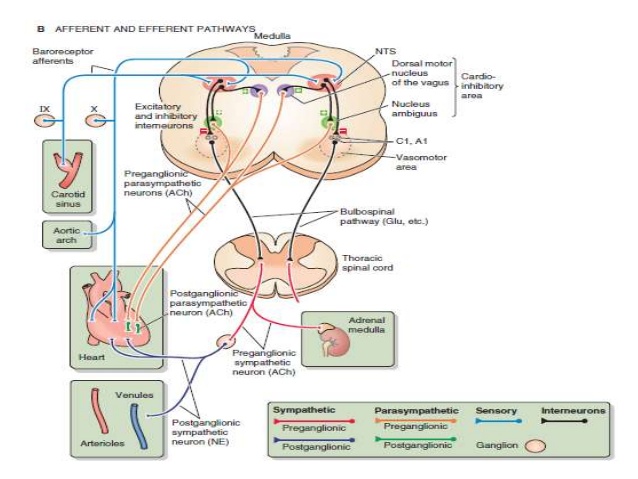
The short-term regulation depends on switch on/ switch off of the sympathetic nervous system and the balance between it and the vagus.
The effect of sympathetic stimulation is (a) on the heart where it causes an increase in heart rate (positive chronotropic effect), stroke volume (positive inotropic effect) and conduction rate (positive dromotropic effect). (b) on the blood vessels where it causes venoconstriction (facilitates venous return) and arteriolar vasoconstriction (increases TPR) (c)on the adrenal medulla (“sympathoadrenal axis”) where it causes release of catecholamines which in turn cause an increase in heart rate, stroke volume, and vasoconstriction.
The baroreceptors present in the aortic and carotid sinus are responsive to stretch .They are stimulated when blood pressure rises, and stimulates (a) the inhibitory neurone and (b) dorsal motor nucleus of the vagus in the vasomotor centre. The inhibitory neurone inhibits discharge of the descending neurone which stimulates the sympathetic neurones, switching off sympathetic discharge. At the same time, the vagus is activated to exert negative inotropic & chronotropic effects on the heart. When blood pressure falls, the discharge from the baroreceptors fall, and the inhibition of the sympathetic system is removed, thus: switching on” the effects of sympathetic stimulation. The peripheral chemoreceptors also send impulses to the vasomotor centre and activate sympathetic discharge.
Long -term regulation of blood pressure
The renin -angiotensin system (RAS) is central to the long-term regulation of blood pressure. A fall in blood volume or blood pressure stimulates the juxtaglomerular apparatus in the kidneys to release renin which acts on angiotensinogen, an alpha2 globulin produced by the liver, to form angiotensin I. Angiotensin I (ANG I) is cleaved into angiotensin II (ANG II) by the angiotensin converting enzyme (ACE) present in the lungs. ANG II is the most potent circulating vasoconstrictor identified. It also stimulates aldosterone release from the adrenal cortex, promoting water and sodium retention, increase in blood volume, venous return, stroke volume and cardiac output.
When there is an expansion of ECF volume e.g after drinking large amounts of water to allay thirst induced by ingestion of salty food, the increase in venous return to the right atrium causes release of atrial natriuretic peptide (ANP) which causes natriuresis and diuresis.
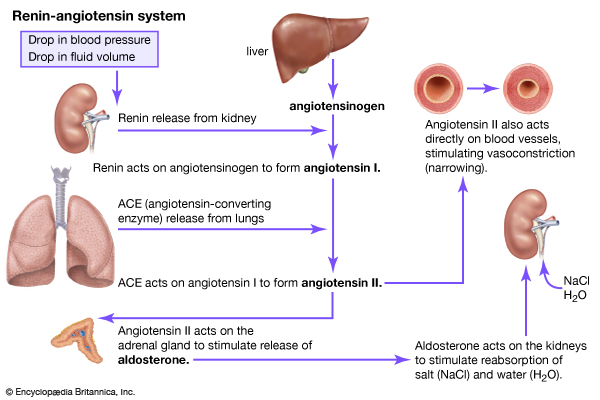
Pathophysiology of hypertension
Secondary hypertension
Renal causes of hypertension are caused through the excessive production of renin
(“High renin hypertension”). “Low renin hypertension” is hypertension resulting from ECF volume expansion which is caused by excessive cortisol production as in Cushing’s Syndrome (cortisol in large amounts exhibits mineralocorticoid activity) or aldosterone production as in congenital adrenal hyperplasia .Hypertension caused by ingestion of candy containing liquorice, or drugs (prednisolone, oral contraceptives ) are reversible. Tumours like phaeochromocytomas cause hypertension by releasing catecholamines inappropriate to the needs of the body. Over activity of the sympathetic nervous system causes hypertension.
Essential hypertension
The causes of essential hypertension have not been satisfactorily elucidated, but may factors have been proposed. Included are age , genes ( being of African or Caribbean origin ), high salt intake, sedentary lifestyles, obesity, chronic sleep deprivation, alcohol, smoking4.
Intense research is underway to identify the genes causing hypertension. . Hypertension is a key feature of some rare genetic disorders, including familial hyperaldosteronism, pseudohypoaldo steronism type 2, Liddle syndrome, Bartter syndrome, Gitelman syndrome, and some tumors5.
High salt intake has long been implicated in the pathogenesis of hypertension. It was noted that the rise in blood pressure with age is not seen in communities ingesting less than 50 mmol of sodium per day6.,8. Guyton 7 explained the rise in blood pressure associated with high salt intake as a reflex vasoconstriction to the high perfusion rates resulting from increased ECF volume; the raised blood pressure facilitates natriuresis and diuresis. However, this explanation may not fit all cases. ECF volume expansion is not demonstrable in all cases and other factors may play a role. There seems to be a subset of salt sensitivity because not all hypertensive patients benefit from salt restriction. A recent study from the USA reported that out of 56.8% of population having hypertension or salt sensitivity or both, 30.4% was hypertensive, of which only 11.6 % was salt-sensitive8. Endothelial dysfunction has been implicated 9and gene mutations and oxidative stress have been demonstrated in SHR (spontaneously hypertensive rats) 10
References
- GBD 2015 Risk Factors Collaborators. Global, regional, and national comparative risk assessment of 79 behavioural, environmental and occupational, and metabolic risks or clusters of risks, 1990-2015: a systematic analysis for the global burden of disease study 2015. Lancet. 2016;388(10053):1659–724.https://www.ncbi.nlm.nih.gov/pubmed/27733284
- Lim SS, Vos T, Flaxman AD, et al. A comparative risk assessment of burden of disease and injury attributable to 67 risk factors and risk factor clusters in 21 regions, 1990–2010: a systematic analysis for the global burden of disease study 2010. Lancet. 2013;380(9859):2224–60. https://www.ncbi.nlm.nih.gov/pubmed
- AungSoeHtet, MB Bjertness, Win MyintOo, MK Kjollesdal, LY Sherpa, KoKoZaw. KoKo, Hein Stiegum, HK Meyer & E Bjertness(2017). Changes in prevalence, awareness, treatment and control of hypertension from 2004 to 2014 among 25-74-year-old citizens in the Yangon Region, Myanmar. BMC Public Healthvolume 17
- Carretero OA &OParil S (2000). Essential Hypertension .Circulation. 101. 329-335.
- Genetics Home Reference. https://ghr.nlm.nih.gov/condition/hypertension
- Hollenberg NK, Martinez G, McCullough M, Meinking T, Passan D, Preston M, Rivera A, Taplin D &Vicaria-Clement ( 1997). Aging, Acculturation, Salt Intake, and Hypertension in the Kuna of Panama.Hypertension. 1997;29:171–176
- Guyton AC. Blood pressure control: special role of the kidneys and body fluids. Science. 1991;252:1813–1816
- Felder RA,White MJ, Williams SM& Jose PA(2013). CurrOpinNephrolHypertens. 22(1): 65–76.
- Drenjančević-Perić I, Jelaković B, LombardJH ,Kunert MP Kibel A and Gros M ( 2011). High-Salt Diet and Hypertension: Focus on the Renin-Angiotensin System Kidney Blood Press Res. 2011 Jan; 34(1): 1–11.
- Leckie BJ. Polymorphisms of the renin gene promoter in spontaneously hypertensive and Wistar-Kyoto rats. ClinExpPharmacol Physiol. 2001;28:60–63
Hla Yee Yee, MBBS(Rgn) ; MSc(Mdy);PhD(Lond);FRCP(Edin)(Hon); Cert.in Leadership for Physician Educators (Harvard Business School)


