Package of Essential Non-Communicable (PEN) Disease Interventions for Primary Health Care in Low-Resource Settings

Prevention and control of Non Communicable Diseases (NCDs)
Current epidemiological evidence indicates that four major NCDs; CVD (heart disease and stroke), cancer, chronic respiratory disease and diabetes, are responsible for 28 million deaths per year in lower middle income country. At the household level, those socioeconomic groups are most at risk of developing chronic diseases and dying prematurely from them, including many middle-aged people. In some cases, this may be because the poor have higher rates of exposure to risk factors such as smoking prevalence and maternal undernutrition. Costly hospital health care required for dealing with heart attacks, strokes, dialysis for kidney disease and complications of diabetes such as amputations can result in catastrophic health expenditure. This can push households more deeply into poverty. Other documented links between poverty and NCDs includerestriction of healthy food and physical activity choices and use of disposable income by the poor on commodities that contribute to NCDs.
Rationale for a core set of NCD interventions
Properly functioning health systems are vital for prevention and control of NCDs and for improving health outcomes in general. First, there should be more investment in prevention and primary care. Second, the cost of treating CVD, diabetes and COPD can be reduced to a minimum by carefully selecting essential evidence-based interventions. Third, the cost of treating complications of NCDs that require hospitalization (e.g. heart attacks, strokes, amputations, blindness due to diabetic or hypertensive retinopathy and end stage renal disease requiring dialysis) can be reduced.
Primary Health Care and NCDs
Both the 1978 WHO Declaration on Primary Health Care and the 2008 World Health Report “Primary health carenow more than ever”,have initiated and reactivated and directedsocial justice, equity and solidarity. Four sets of PHC reforms are required for providing an effective response to health challenges. These reforms address universal coverage, service delivery, leadership and governance and public policy. The key features of a health system led by primary care include: (i) a person focus across the lifespan rather than a disease focus; (ii) accessibility with no out-of-pocket payments: (iii) distribution of resources according to population needs rather than demand; and (iv) availability of a broad range of services including preventive services and coordination between different levels in the health system.As a starting point, a core set ofevidence-based interventions to be provided to address the major NCDs, starting at the primary care level, followed by the township/districthospital level. Then, it could be expanded to other NCD areas.
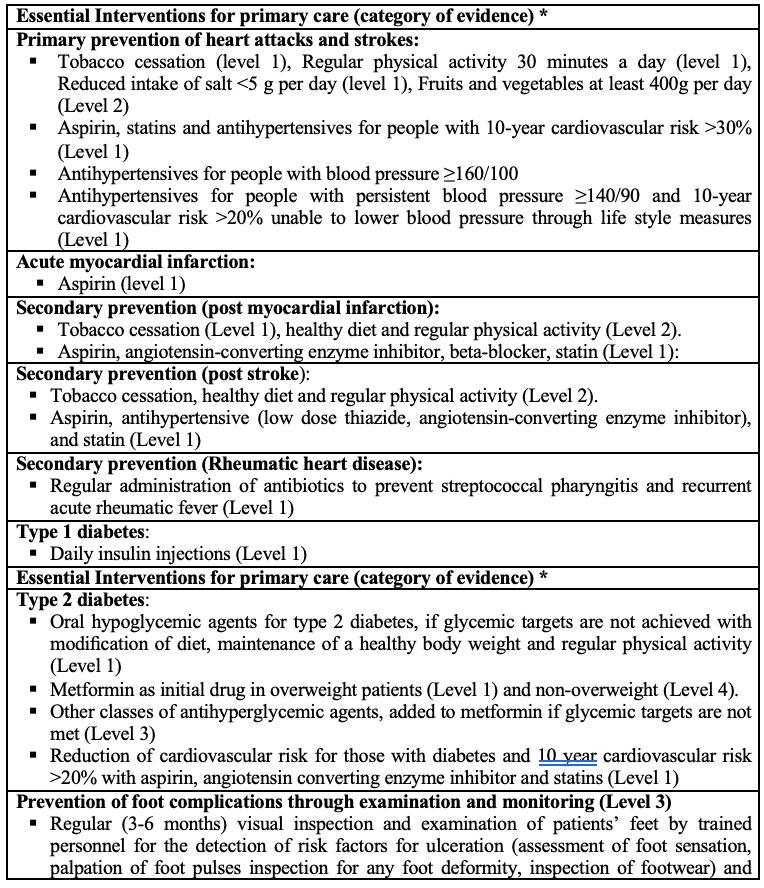
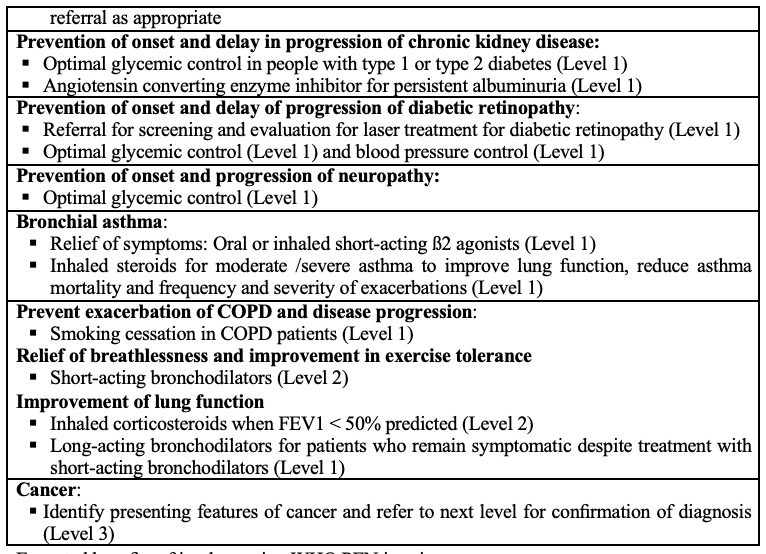
A minimum set of intervention is defined in the WHO Package of Essential NCD (WHO PEN) interventions. Interventions selected are those that are feasible for implementation even in low-resource settings with a modest increase in investment. They can be delivered by primary care physicians or general practitioners and basic health workers in primary care. The interventions include detection, prevention, treatment and care of CVD and risk factors (heart disease, stroke, hypertension), diabetes, chronic respiratory disease (asthma and COPD) and cancer. The aim of such a package is to provide an equitable framework for starting work to scale-up primary care as country strive to achieve universal access in the health sector.
Table1. A core set of evidence- based interventions for reducing morbidity and mortality from major NCDs.
Expected benefits of implementing WHO PEN in primary care:
For equity and efficiency of Primary Health Care, implementation of the package will help to strengthen the health services delivery and the management of the PHC system through increasing the proportion of primary health facilities that have trained professional for diagnosis and treatment of NCDs; providing feasible technical guidance on diagnosis and treatment of major NCDs and guidance on essential equipment and affordable medicines for the diagnosis and treatment.
Essential technologies and medicines and risk prediction tools for primary care:
A wide array of medical technologies is utilized for the management of NCDs. In the interests of equity, a prioritized set of technologies has to be made available in primary care based on population needs. These technologies include a few core medical devices such as weighing scales, sphygmomanometers, peak flow meters and equipment for urine albumin and blood glucose analysis. If combined with trained personnel and referral systems, these basic technologies will enable most patients with major NCDs to be treated close to client facilities and will help to enhance utilization of primary care services.
Essential medicines for prevention and control of major NCDs
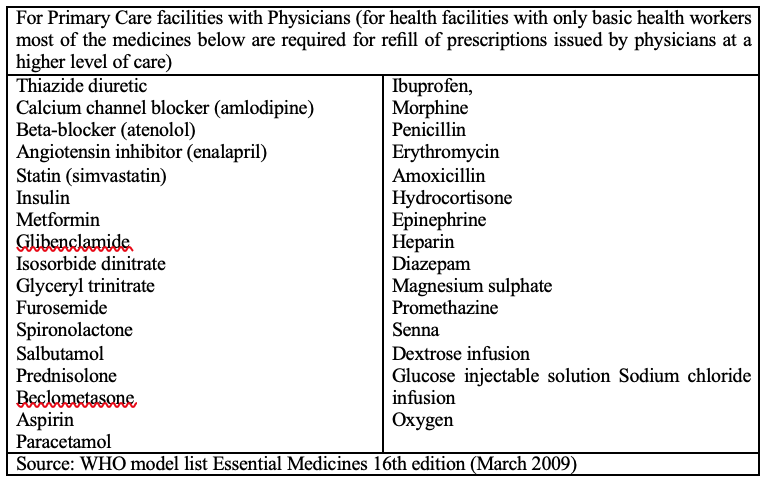
Evidence indicates that affordable and effective medicines for NCDs are unavailable in many countries and, in a few instances when they are available, they are largely unaffordable or of poor quality. The attendant out-of-pocket expenditures for essential medicines may discourage appropriate use of medicines, and generally reduce the potential for adherence to treatment. A core set of essential medicines need to be made available (Table 3).
Table 3. Core list of medicines required for implementing essential NCD interventions in primary care
Protocols for primary care are already developed by WHO and protocols covered the following
Protocol (1) Prevention of heart attacks and kidney diseases through integrated management of diabetes and hypertension
Protocol (2) Health education and counseling for healthy behaviors
Protocol (3) Management of asthma and management of chronic obstructive pulmonary diseases (COPD)
Protocol (4) Assessment and referral of women with suspected breast cancer at primary health care
Country status of NCD implementation
Myanmar has a population of 54,315,448 (2019). Epidemiological transition is taking place in the country towards rising NCD.Adults 94% live with at least one risk factor of NCDs as per the findings of STEP survey, 2014and 68% deaths due to NCDs (WHO-2017).Myanmar has implemented vertical or separate projects of non-communicable diseases for decades. With the rising global trend of NCDs and transition to rising NCD morbidity and mortality pattern, NCD unit was established in 2015 in Department of public health under Ministry of Health and Sportand covered the various projects include diabetes, hypertension, cancer, COPD, injury, mental, epilepsy, deafness, snake bite, rehabilitation.Screening and treatment (PEN approach) and training of basic health staff was done so far in 252 townships out of 330 townships in the Union. Services delivery reached up to the community level run by midwives and other basic health workers.
The services provided are screening of hypertension, diabetes, oral, cervical and breast cancer andbasic health staffs have been trained to be able to calculate CVD risk by using simple charts developed by WHO. Prioritized interventions are tax and price measures like increase taxes and prices on tobacco and alcohol and simplify tax structure (e.g., removing tiers) as per WHO recommendations and Effective taxation on Sugar-Sweetened Beverage (SSB) was introduced.School-based programmes are implemented for reduction of NCD risk factors, e.g., 100% smoke free schools, no sale of sugary drinks in school.
Conclusion
Essential interventions, technology, tools and medicines and equipment are based on the level of service delivery. At the present moment PEN is implemented in the public or government health facilities and by government health staff. The similar interventions and technology and tools could be implemented in the private sector by widely available general practitioners throughout the country.
References
Lancet, (2017) Worldwide trends in blood pressure from 1975 to 2015: a pooled analysis of 1479 population-based measurement studies with 19·1 million participants, NCD Risk Factor Collaboration (NCD-RisC),vol.389
World Health Organization, (2013) Implementation tools, Package of Essential Non communicable (PEN) diseases interventions for primary health care in low resource setting
World Health Organization, (2012) Guidelines for primary health care in low resource setting Prevention and control of Non communicable (PEN) diseases.
Dr. Ye Hla, Retired Director (Research)
Dr. Kyaw Kan Kaung, Director, NCD programme, Department of Public health