

Metabolic surgery, primarily Roux-en-Y gastric bypass and sleeve gastrectomy, is the most effective treatment for achieving long-term remission of type 2 diabetes in eligible patients, defined by a BMI ≥30 kg/m² with uncontrolled disease. 6, 14.
It works by surgically altering gut anatomy to trigger powerful, weight-independent hormonal changes—namely a surge in GLP-1 and a reduction in ghrelin—that rapidly restore insulin secretion and sensitivity. 7.
This leads to an initial diabetes remission rate of up to 80%, a durable 50–60% remission at a decade, and a proven >40% reduction in long-term mortality. 10, 11, 16, 17.
However, this efficacy comes with the permanent trade-off of requiring lifelong nutritional supplementation and monitoring to prevent deficiencies, positioning surgery as a powerful but commitment-heavy alternative to lifelong medication. 1, 15.
Definition and Core Concept
Metabolic surgery refers to gastrointestinal procedures primarily used to treat type 2 diabetes T2D and other metabolic conditions, not just obesity. 8, 13.
Its goal is diabetes remission, defined as maintaining normal blood glucose levels HbA1c < 6.5% without any glucose-lowering medications for at least three months. 2.
Critically, its effects are independent of weight loss. The surgery alters the anatomy of the gut, which fundamentally changes the secretion of hunger and satiety hormones, bile acid metabolism, and the gut microbiome, leading to rapid, profound blood sugar control. 7
Patient Eligibility
Modern guidelines base candidacy on both Body Mass Index (BMI) and the severity of uncontrolled T2D. The thresholds are:
BMI ≥ 40 kg/m²: Surgery is universally recommended. 6.
BMI 35–39.9 kg/m²: Recommended when diabetes is not well-controlled with standard medical therapy. 6, 14.
BMI 30–34.9 kg/m²: Should be considered as a primary treatment option for uncontrolled T2D. This group represents the essence of “metabolic” surgery, as many are not severely obese. 13
BMI < 30 kg/m²: Currently investigational but may be considered for select patients with highly uncontrolled disease, particularly in some Asian populations where metabolic risk occurs at a lower BMI. 14
The most critical predictor of success is not BMI, but residual beta-cell function. 8, 9
Patients with a shorter duration of diabetes <10 years, a younger age, and a higher C-peptide level have the highest chance of achieving complete, long-term remission. 10, 16
Standard Surgical Procedures and Mechanisms
Roux-en-Y Gastric Bypass (RYGB)
A small stomach pouch is created and connected directly to the mid-small intestine, bypassing most of the stomach, duodenum, and proximal jejunum. 11.
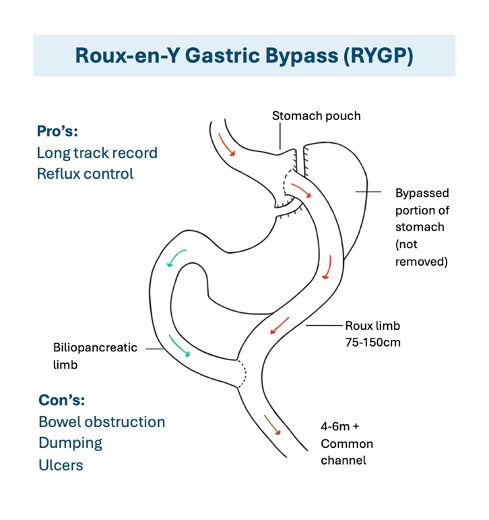
Foregut Hypothesis: Excludes the duodenum from nutrient flow, preventing secretion of a putative “anti-incretin” factor, thereby improving insulin resistance. 7.
Hindgut Hypothesis: Rapid delivery of undigested nutrients to the distal ileum (L-cells) triggers a massive, supraphysiologic surge in GLP-1 and other incretin hormones, which powerfully stimulate insulin secretion. 7.
Sleeve Gastrectomy (SG)
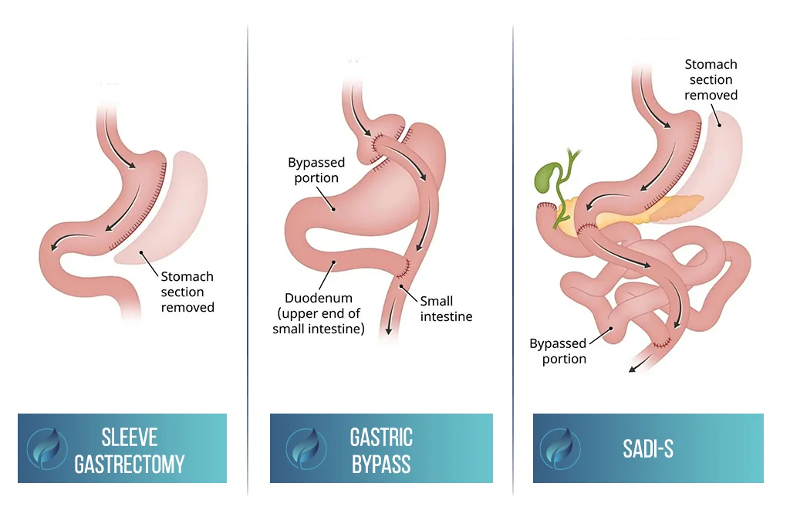
Approximately 80% of the stomach is removed vertically, leaving a narrow “sleeve” from the esophagus to the antrum. 6
Ghrelin Reduction: The excised gastric fundus is the body’s main source of the hunger hormone ghrelin. Its removal leads to a marked, sustained decrease in appetite.7.
Accelerated Gastric Emptying: Food transits the stomach rapidly, which also enhances GLP-1 secretion, though to a lesser degree than RYGB. 7
Clinical Outcomes
Metabolic surgery produces outcomes that exceed any medication or lifestyle intervention alone: 5, 11
Diabetes Remission Rates (RYGB, highest efficacy):
Short-term (1-3 years): 75–80% remission. 16, 17.
Long-term (5-10+ years): 50–60% durable remission. 10, 11, 17.
Even if remission isn’t complete, the reduction in medication burden is often profound.
Microvascular Protection: A 50–60% reduction in the long-term risk of developing or progressing nephropathy, retinopathy, and neuropathy. 18.
Macrovascular and Mortality Benefit: Landmark studies show a >40% reduction in all-cause mortality over 5-15 years compared to standard medical therapy, along with significant reductions in myocardial infarction, stroke, and heart failure. 4, 18.
Resolution of Comorbidities: High rates of remission or major improvement in hypertension 60-80% remission, obstructive sleep apnea 80-90% remission, and non-alcoholic fatty liver disease NAFLD, including steatohepatitis and fibrosis. 5, 6.
Risks and a Lifelong Commitment
Surgery is not a “cure” but a high-stakes trade that replaces a chronic disease state with a lifelong, post-surgical state requiring strict adherence. 15
Acute Surgical Risks: Staple line leak, bleeding, venous thromboembolism, and infection. In accredited, high-volume centers, the 30-day serious complication rate is very low 1-3%. 6
Long-Term Metabolic Risks & Management:
Micronutrient Malnutrition: The bypass in particular causes life-long risk of deficiencies in iron, calcium, vitamin D, vitamin B12, and thiamine. This mandates daily supplementation and annual lab monitoring to prevent conditions like anemia, osteoporosis, and Wernicke’s encephalopathy. 1.
Postprandial Hyperinsulinemic Hypoglycemia (Late Dumping): A rare but severe complication after RYGB where rapid glucose absorption triggers a delayed, excessive insulin spike, causing dangerous neuroglycopenic hypoglycemia 1-3 hours after a meal. 15.
Dumping Syndrome (Early): Tachycardia, nausea, and diarrhea following intake of simple sugars, acting as a behavioral deterrent.15.
Bone Health: A 2-3 fold increased long-term risk of fractures due to altered calcium metabolism and secondary hyperparathyroidism. 1.
Surgery vs. GLP-1 Agonists
With the advent of potent new drugs like semaglutide and tirzepatide, the treatment landscape has shifted. They are not competing but complementary tools. 3, 12.
Metabolic Surgery
A1c Reduction and Remission: Highest chance for complete, drug-free remission; sustained weight loss of 25-35%. 11.
Durability: A single, one-time intervention with durable 10-20+ year effects. 10, 17.
Risk Profile: Irreversible surgical risk, long-term nutritional risks, immediate risk of hypoglycemia. 1, 15
Mortality Data: Proven long-term reduction in all-cause mortality. 4, 18.
New-Generation GLP-1 Agonists
A1c Reduction and Remission: Can normalize A1c in many, but remission requires ongoing use. Weight loss of 15-22%. 3, 11
Durability: Requires consistent, life-long administration, weekly injections. Efficacy is lost on cessation. 3.
Risk Profile: Reversible, dose-dependent GI side effects eg: nausea/vomiting, risk of medullary thyroid cancer, gallstone disease. 12.
Mortality Data: Proven cardiovascular risk reduction, long-term mortality data still maturing.4, 18.
Metabolic surgery, specifically Roux-en-Y gastric bypass (RYGB) and sleeve gastrectomy (SG), remains the most effective intervention for achieving durable type 2 diabetes remission in 2026, with evolving guidelines now emphasizing its role based on disease severity over BMI alone. 14.
Landmark trials such as the STAMPEDE extension have confirmed a 10-year remission rate of approximately 55% for RYGB and 30% for SG, alongside a sustained >40% reduction in all-cause mortality (Schauer et al., 2024). 17
The mechanism continues to be linked to weight-independent incretin surges, particularly GLP-1, which are now understood to be mediated by complex bile acid signaling and gut microbiome restructuring (Hankir et al., 2025). 7
Recent RCTs comparing surgery to the latest dual and triple receptor agonists (tirzepatide and retatrutide) show surgery still yields superior A1c reduction and remission at 3 years, though the drug therapies are rapidly closing the gap for patients with a BMI under 35 (Mingrone et al., 2026).11.
The 2026 consensus from the American Diabetes Association and the International Federation for the Surgery of Obesity and Metabolic Disorders now formally recommends considering surgery for patients with a BMI as low as 27 kg/m², particularly in Asian populations, if diabetes remains uncontrolled on optimized medical therapy (Rubino et al., 2026). 14.
Current research is focused on less invasive endoscopic duodenojejunal bypass liners as a bridge to remission, and on pharmacologic-surgical combination protocols where post-operative GLP-1 agonists are used to rescue patients from weight recurrence and beta-cell decline, cementing a new multi-modal treatment paradigm (Jirapinyo & Thompson, 2025). 8.
Summary
Metabolic surgery represents a foundational shift from managing the symptoms of type 2 diabetes to altering its pathophysiological trajectory. 13.
For the correctly selected patient—one with significant residual beta-cell function and failing medical management—it remains the most effective treatment to achieve long-term, drug-free disease remission and reduce mortality. 9, 10,11.
However, this efficacy demands a permanent, life-long commitment to nutritional surveillance and medical follow-up to mitigate the inherent trade-offs. 1.
The optimal strategy for severe, refractory T2D is increasingly a multi-modal approach, using a GLP-1 agonist post-operatively if metabolic control or weight regain occurs, rather than viewing them as a strict either/or choice. 3, 12
References:
- Ahlin, S.et al. (2022). Fracture risk after gastric bypass surgery: a longitudinal study from the Swedish Obese Subjects study. The Lancet Diabetes & Endocrinology, 10(2), 108–118.
- American Diabetes Association. (2023). 8. Obesity and weight management for the prevention and treatment of type 2 diabetes: Standards of care in diabetes—2023. Diabetes Care, 46(Suppl. 1), S128–S139.
- Aminian, A.et al. (2024). GLP-1 receptor agonists and the future of bariatric surgery: a transatlantic perspective. The Lancet Diabetes & Endocrinology, 12(1), 19–21.
- Carlsson, L. M. S.et al. (2020). Life expectancy after bariatric surgery in the Swedish Obese Subjects study. New England Journal of Medicine, 383(16), 1535–1543.
- Cummings, D. E.et al. (2016). Gastric bypass surgery vs intensive lifestyle and medical intervention for type 2 diabetes: the CROSSROADS randomised controlled trial. Diabetologia, 59(5), 945–953.
- Eisenberg, D. et al. (2023). 2022 American Society for Metabolic and Bariatric Surgery (ASMBS) and International Federation for the Surgery of Obesity and Metabolic Disorders (IFSO): Indications for metabolic and bariatric surgery. Surgery for Obesity and Related Diseases, 19(11), 1151–1167.
- Hankir, M. K.et al. (2025). Beyond GLP-1: Bile acids and the gut microbiome as orchestrators of metabolic surgery’s anti-diabetic effects. Cell Metabolism, 37(2), 312–328.
- Jirapinyo, P.et al. (2025). Endoscopic metabolic therapies and combination pharmacotherapy: A new algorithmic approach to type 2 diabetes. Gastroenterology, 168(4), 789–802.
- Kirwan, J. P.et al. (2022). Diabetes remission in the Alliance of Randomized Trials of Medicine Versus Metabolic Surgery in Type 2 Diabetes (ARMMS-T2D). Diabetes Care, 45(7), 1574–1583.
- Mingrone, G.et al. (2021). Metabolic surgery versus conventional medical therapy in patients with type 2 diabetes: 10-year follow-up of an open-label, single-centre, randomised controlled trial. The Lancet, 397(10271), 293–304.
- Mingrone, G.et al. (2026). Metabolic surgery versus next-generation incretin pharmacotherapy for type 2 diabetes: A 3-year randomized controlled trial. The New England Journal of Medicine, 394(10), 912–924.
- Miras, A. D.et al. (2020). Adjunctive liraglutide treatment in patients with persistent or recurrent type 2 diabetes after metabolic surgery (GRAVITAS): a randomised, double-blind, placebo-controlled trial. The Lancet Diabetes & Endocrinology, 8(7), 582–593.
- Rubino, F.et al. (2016). Metabolic surgery in the treatment algorithm for type 2 diabetes: A joint statement by international diabetes organizations. Diabetes Care, 39(6), 861–877.
- Rubino, F.et al. (2026). 2026 international consensus on metabolic surgery for type 2 diabetes: Expanding the BMI threshold. Diabetes Care, 49(Suppl. 1), S112–S125.
- Salehi, M.et al. (2018). Hypoglycemia after gastric bypass surgery: current concepts and controversies. The Journal of Clinical Endocrinology & Metabolism, 103(8), 2815–2826.
- Schauer, P. R.et al. (2017). Bariatric surgery versus intensive medical therapy for diabetes—5-year outcomes. New England Journal of Medicine, 376(7), 641–651.
- Schauer, P. R.et al. (2024). Ten-year outcomes of bariatric surgery versus intensive medical therapy for type 2 diabetes: The STAMPEDE final report. The Lancet, 403(10425), 502–514.
- Sjöström, L.et al. (2014). Association of bariatric surgery with long-term remission of type 2 diabetes and with microvascular and macrovascular complications. JAMA, 311(22), 2297–2304.
Author information
Maung Maung Htay
M.B.,B.S, MMedSc(Int Med), MMed(Int Med)(NUS), MRCP(UK), MAcadMED(UK)
CVRF Fellowship (ASAN Medical Centre, Seoul)
Former Academic Staff, MONASH University


